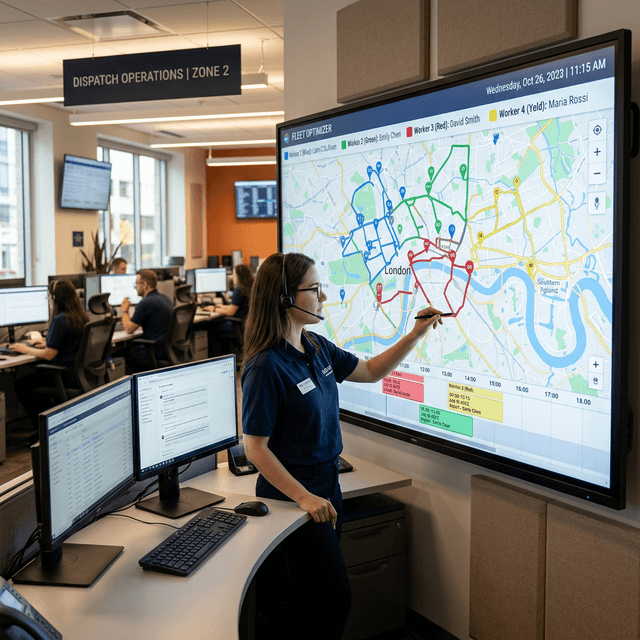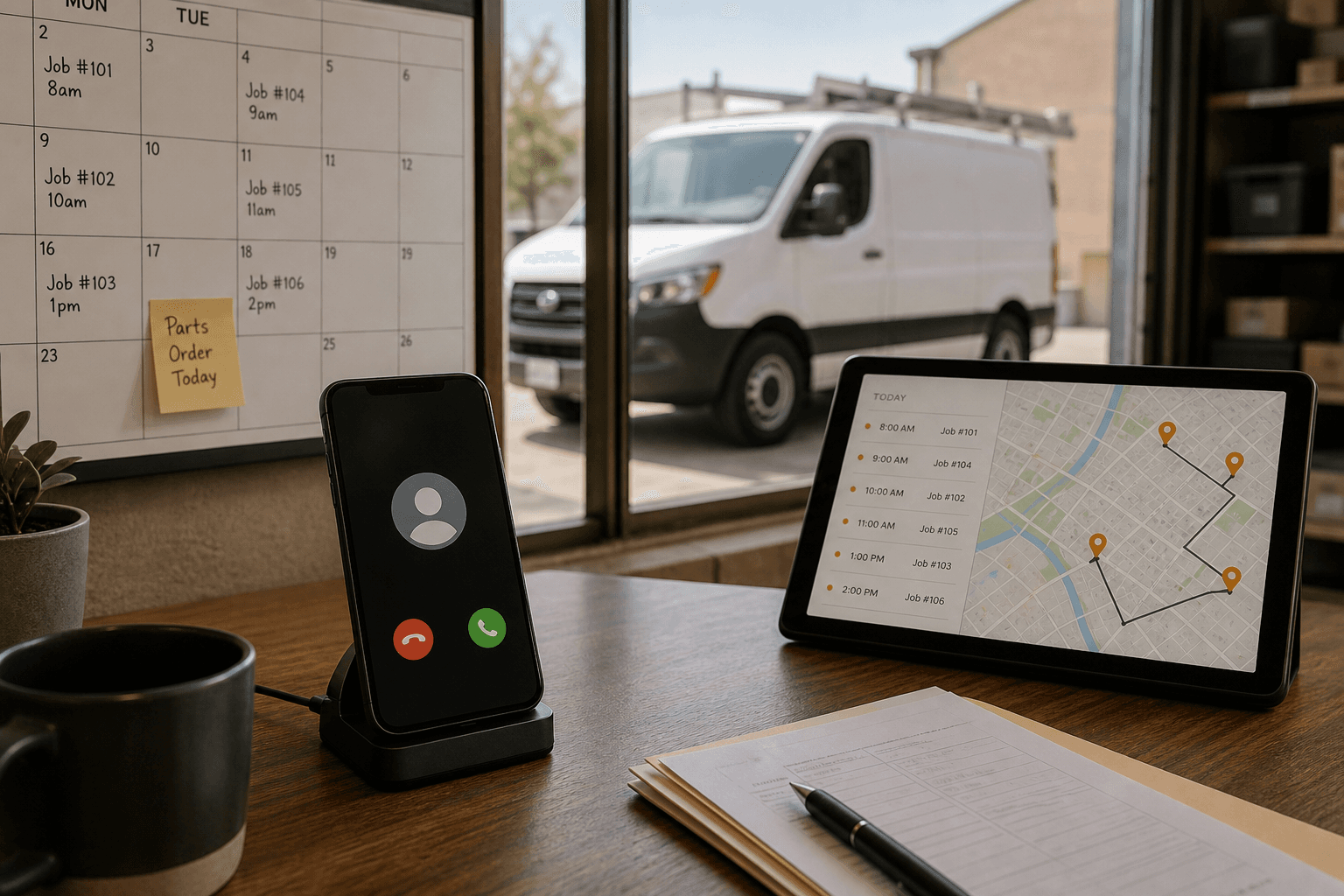
An AI phone receptionist for field service does more than greet callers — it qualifies the job, checks capacity, and books the appointment. Traditional answering services and bolt-on chatbots stop at messages. DispatchNode’s native AI receptionist is built into AI dispatch software, so every answered call can become a scheduled job. See live pricing and book a demo.
Why contractors are searching for an AI phone receptionist
HVAC, plumbing, electrical, and specialty trade owners already know the pattern: the phone rings during a job, during lunch, or at 9 PM. A human can’t answer every line. Voicemail converts poorly. A $300–$800/mo answering service takes a name and a callback request — then your dispatcher spends the next morning chasing leads that already hired someone else.
That is why operators search for an AI phone receptionist, an AI answering service, and software that answers calls and books jobs. They are not looking for another IVR tree. They want a front door that closes revenue.
"We didn’t need another message taker. We needed the phone to book the no-heat call while the tech was still on the prior job. That’s the difference between an answering service and an AI receptionist."
What an AI phone receptionist actually does
An AI phone receptionist is a voice agent trained on your services, service area, pricing rules, and schedule. On a live call it should:
- Answer instantly — nights, weekends, and peak heat/cold surges before the third ring.
- Qualify the job — service type, urgency, address / ZIP, and equipment notes.
- Check the calendar — open capacity, zone rules, and skill tags on technicians.
- Book or escalate — write the job, send confirmation texts, or hand off complex quotes.
- Log everything — keep the CRM / dispatch board as the single source of truth.
If the agent only takes a message, you bought a fancy answering service — not a receptionist for a field business. Product detail lives on our AI receptionist and AI answering service pages.
AI phone receptionist vs traditional answering service
| Capability | Traditional answering service | Bolt-on AI chatbot on FSM | Native AI receptionist (DispatchNode) |
|---|---|---|---|
| Pickup | Human or scripted IVR | Usually fast | Instant, 24/7 |
| Job booking | Callback / message only | Often message + fragile sync | Writes to live schedule |
| Price / FAQ | Script sheet | FAQ only | Price book + service rules |
| After-hours emergencies | Message queue | Message or basic intake | Book emergency window when capacity allows |
| Cost model | Per-minute / seat | FSM license + AI minutes | Consolidated platform |
| Latency to calendar | Hours (human follow-up) | API round-trips | Native state machine |
The booking gap: Message-takers create work for your office. A true AI phone receptionist for contractors removes that loop — the same agent that greets the caller owns the appointment.
Built for HVAC, plumbing, and trade contractors
Generic “AI receptionist” tools optimized for dental or legal offices miss field-service nuance: emergency vs maintenance, parts on the truck, multi-stop routes, and deposit collection before a tech rolls. Trade-specific examples:
- HVAC — heat/AC urgency, unit age, filter vs diagnostic vs install; surge pricing windows in heat waves
- Plumbing — flood vs clog vs water heater; after-hours dispatch rules
- Electrical — panel work vs fixture swap; license/skill tags so the wrong tech never gets booked
- Specialty trades — hood cleaning, mobile repair, grease trap: capture compliance fields on the first call
Vertical demos and industry pages show how the same AI operating system adapts per trade — see industries and live brands like PetPickupNow / EasyPotty / GreaseTrap for consumer-facing proof of 24/7 intake.
Why bolt-on AI stalls at “answering machine”
Legacy field service platforms often market “AI” by wiring a third-party voice vendor into a decade-old CRM. The agent can greet and FAQ — but it does not own the scheduling state machine. That leaves you at Level 1 on the automation scale (see 5 levels of AI dispatch automation): overflow capture without headcount replacement.
DispatchNode was built as AI dispatch software with voice native to the calendar. The receptionist and the dispatcher share one brain — no double billing for CRM + per-minute AI, and no 1,500ms API awkwardness mid-sentence.
What “software that answers calls and books jobs” is worth
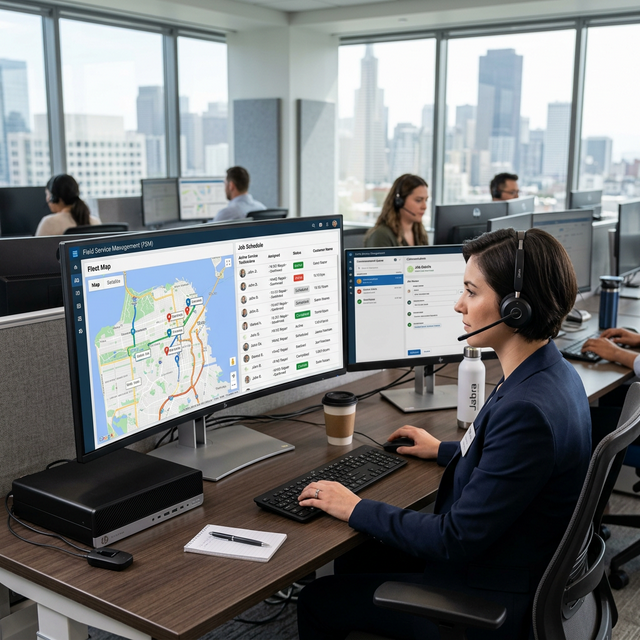
Owners evaluating a 24/7 answering service for contractors should price the alternative in jobs, not minutes:
- One rescued emergency often covers a month of software
- Zero voicemail compounds every weekend and holiday
- Dispatcher hours return to routing, QA, and customer recoveries — not phone tag
For the full leakage math, read The 2026 cost of missed service calls. For ROI framing, see measuring AI dispatch ROI.
Evaluating FSM “alternatives” with receptionist in mind
Comparison shoppers still type ServiceTitan alternative, Jobber alternative, and Housecall Pro alternative. When you shortlist, ask one receptionist question: Does the voice agent write the job, or only the ticket?
How to roll out an AI receptionist this week
Use this pre-go-live checklist before you forward production traffic:
- -Main line (or dedicated marketing DID) ready to forward to the AI agent
- -Services, ZIP zones, emergency flags, and tech skill tags loaded
- -Booking rules set — what the AI may book live vs Shadow Mode approval
- -Payments connected — deposits on emergencies if you require them
- -Three scripts tested — after-hours emergency, price shopper, wrong ZIP
- -Human overflow path confirmed for edge cases while you relax constraints
Most operators are live in under 30 minutes of configuration. Book a walkthrough on meet, review pricing, or start a trial on sign-up.
Frequently asked questions
Will customers know it’s AI?
They will notice speed and consistency. Position it honestly: “Our AI receptionist books you while the crew is on the road.” Trust comes from accurate ETAs and confirmations — not pretending a human is typing.
Can it speak more than English?
DispatchNode supports 29+ languages so after-hours callers are not forced into English-only voicemail.
What if the job is too complex to book?
Configure Shadow Mode or live handoff. The AI gathers address, photos, and scope, then routes to a human for quote approval — without losing the caller to a competitor’s first ring.
Does this replace my FSM entirely?
For many small and mid-size operators, yes — voice, schedule, and payments in one platform. Others run DispatchNode as the intake + dispatch layer beside existing accounting tools. Compare paths on /compare.
Claims ledger
Product claims in this article map to published DispatchNode sources — not aspirational marketing:
- AI voice receptionist is included on published paid tiers (Starter and above) — not sold as a separate bolt-on minute plan. See pricing.
- Published base plan starts at Starter (from $299/mo per location). Older “from $99” references describe a grandfathered Minimum sandbox and are not the current public offer.
- Trial: 14 days; confirm live checkout copy on sign-up.
- Answer SLA (<3 sec) and voicemail-abandon / leakage benchmarks cite DispatchNode’s 2026 internal service-business benchmark; treat as directional, not a guarantee for every market.
- 29+ languages, Shadow Mode / live booking, Stripe deposits, and native calendar write are product capabilities documented on /ai-receptionist and /features.
Next steps
If your phones still dump to voicemail after 5 PM, an AI phone receptionist is the highest-leverage fix — not another marketing spend to fill a leaky funnel.